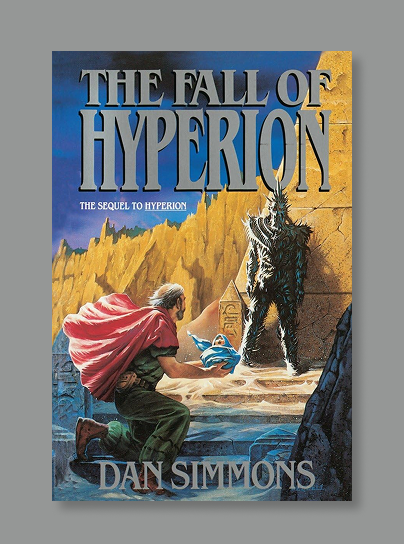
The Fall of Hyperion
Book 2 of the Hyperion series
A dense space opera that is by turns, emotional, political, fantastical, technological, literary, and gory. This is a science-fiction masterpiece.
At the end of the first book, our small group of pilgrims had arrived to the Valley of the Time Tombs to meet with the Lord of Pain, a 15-foot composition of blades, saws, razor-wire, pokey things and fire, called the Shrike. Legend has it that only one person per pilgrimage gets their wish granted; the rest die a painful, bloody death.
Silenus looked around. The great dining hall was quite dark except for the fitful glow of starlight and distant explosions through the panes and ivy above. The tables around him were mere shadows, the walls, thirty meters away in all directions, darker shadows laced through with the varicose darkness of desert creeper. Outside the dining hall, the evening wind had risen, its voices louder now, contralto and soprano solos being sung by cracks in the jagged rafters and rents in the dome above him.
One by one, each person has their own interactions with the Shrike, but it isn’t like a horror movie in which the hapless group of people gets picked off one by one by the bad guy. This is much more nuanced and intellectually compelling.
Yes, some people die and others disappear, but people reappear too. One person is impaled on the Tree of Thorns, one person dies and is reborn as someone else, one person who went missing on the journey in shows up wandering around the valley dehydrated and terrified, another is rendered brain-dead by the Lord of Atonement but later, when she reappears, her importance in the story has increased greatly.
That storyline alone is enough to make a great novel, but this book has many, many layers.
There is another storyline in which the three forces that exist in the universe - the Hegemony, the Outsters, and the AI Technocore - are at war. That political storyline, which of course intersects with the experience of the pilgrims, revolves around the Hegemony CEO Meina Gladstone who is a super well-drawn, formidable character whose objectives are not always clear.
In this book of the series we come to understand the consequences to humanity of having embedded Core technology into every aspect of its daily existence; how it has undermined its ability to exist independently of the Core without even noticing it.
The megasphere, Brawne sees, is as alive and interactive as the biosphere of any Class Five world: forests of green-gray data trees grow and prosper, sending out new roots and branches and shoots even as she watches; beneath the forest proper, entire microecologies of dataflow and subroutine AIs flourish, flower, and die as their usefulness ends; beneath the shifting ocean-fluid soil of the matrix proper, a busy subterranean life of data moles, commlink worms, reprogramming bacteria, data tree roots, and Strange Loop seeds works away, while above, in and through and beneath the intertwining forest of fact and interaction, analogs of predators and prey carry out their cryptic duties, swooping and running, climbing and pouncing, some soaring free through the great spaces between branch synapses and neuron leaves.
We also learn that the Core has been building its version of God, called the Universal Intelligence, with which it plans to battle the human God.
Throughout the book, there is a lot of contemplation about the relationship between creator and created, the aspects of a godhead, and what was really going on when God asked Abraham to sacrifice his son. Even if you’re not religious, the reframing of ideas is intriguing.
We're also exposed to the Outsters, their culture and certain individuals. They aren’t the barbarians that the Hegemony and the Core make them out to be. Not by far. The part of the book that deals with the Outsters is fascinating.
The Consul sighed again and moved aside with the others as, above them, a great butterfly with wings of solar cells and glistening skin impervious to hard vacuum or harder radiation lowered itself toward the Stonehenge circle and opened its belly to receive the Consul.
This is a literary tour de force not only because it weaves together storylines that are each substantial enough on their own, also because through his mastery of description, the author creates a solid perception in the reader’s mind of many unique planets, many different individuals, and some complex, intertwined, inter-personal dynamics.
Not only are the various storylines meaty and the universe the author builds so wide and solid, it’s also scholarly science-fiction. Because one of the pilgrims is a poet, and the cybrid of John Keats is a main character, we are exposed to Keats' poetry as well as literary and historical references. Even the name of the series, Hyperion, is from a John Keats poem. It’s so good!
I suddenly imagine us sitting up long nights in that dark hulk of a building as I teach him how to pair such technique with masculine or feminine caesura, or the joys of alternating iambic foot with unstressed pyrrhic, or the self-indulgence of the frequent spondee.
Mr. Simmons is an extremely proficient and accomplished writer. This series is substantial, challenging, dramatic, and nuanced. I’m really enjoying it. 100% recommended.
Read more reviews