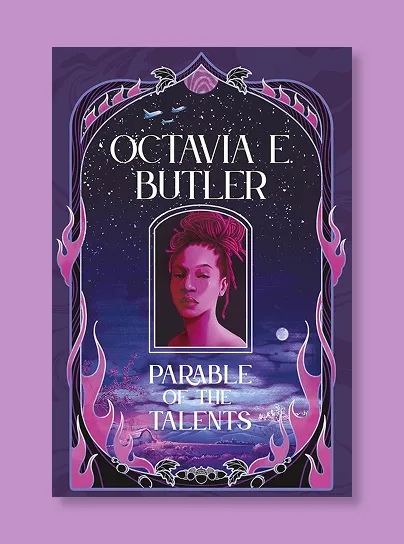
Parable of the Talents
Book 2 of the Earthseed duology
The second in an unfinished series, this one continues with the narrative choice made in the first book of being told as a series of journal entries. This one, though, includes entries from the protagonist, her husband, and their daughter.
We follow along as the Earthseed community the protagonist created in the first book grows and deals with the challenges of a crumbling, increasingly-fascist America. Many people are living a nineteenth century existence; they're poor, lost, and looking for a leader who looks like they have a plan. Violence is the order of the day as people are willing to steal and kill for a meal or a gun. Most of the population is illiterate and children are stolen and sold into slavery of the worst kind.
...any process that cannot or should not be resisted or avoided must somehow be partnered.
Partner one another.
Partner diverse communities. Partner life. Partner any world that is your home.
Partner God.
Only in partnership can we thrive, grow, Change.
Only in partnership can we live.
It’s stunning that this was written in the 1990’s because it foretells Trump’s America in astounding detail. The leader that gets elected devalues education, makes women and brown people second-class citizens, separates children from their parents so the children can grow up in households that believe in his vision, tries to disembowel the constitution, conflates politics and religion, and starts wars he has no business being in. The leader Ms Butler creates in this book even uses the slogan “Make America Great Again”. What incredible foresight Ms. Butler had to see where America was headed so many decades ago!
Amid all this, somehow, the United States of America suffered a major nonmilitary defeat. It lost no important war, yet it did not survive the Pox [the apocalypse]. Perhaps it simply lost sight of what it once intended to be, then blundered aimlessly until it exhausted itself.
Like any Octavia Butler novel, this one is gripping, one can’t stop reading it, but whew, it’s grim. There is isn’t a single moment of levity, happiness, or joy. There isn’t a time frame that is passed with “and things were great for a few years” unless you count the last pages of the epilogue. It's depressing, but Ms Butler's skill at keeping a storyline taut propels the reader to continue.
But we can do something no other animal species has ever had the option to do. We can choose: We can go on building and destroying until we either destroy ourselves or destroy the ability of our world to sustain us. Or we can make something more of ourselves. We can grow up.
There were six books planned in this series (tentatively titled Parable of the Trickster, Parable of the Teacher, Parable of Chaos, and Parable of Clay), but it feels right that the story stopped here.
Ms. Butler began Parable of the Trickster many times, but eventually put it aside to work on her final book, Fledgling, saying she was blocked creatively. (Her attempts to move this story forward can be found in her papers at the Huntington Library in San Marino, California).
Darkness
Gives shape to the light
As light
Shapes the darkness.
Death
Gives shape to life
This novel is about believing in oneself, being willing to hold on to a set of healthy, loving values at a time when the rest of the population has gone mad, and of an extraordinary woman whose goals encompassed all of humanity. This is an excellent read.
Read more reviews