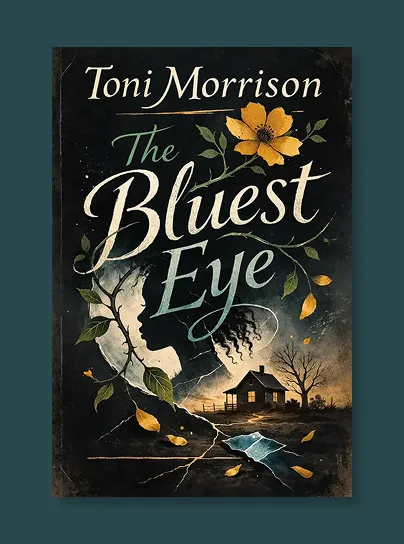
The Bluest Eye
Even though it wasn’t received well by her community, Toni Morrison’s genius is evident even in this, her debut novel. It deals with trauma, internalized unrealistic standards of beauty that fracture one’s wholeness, broken families, domestic violence, and other even more unfortunate experiences. When the book was published in 1970, black readers were not happy that Ms. Morrison chose to expose these things in her book, but really, those things happen in families and communities of every color.
She seemed to fold into herself, like a pleated wing. Her pain antagonized me. I wanted to open her up, crisp her edges, ram a stick down that hunched and curving spine, force her to stand erect and spit the misery out on the streets.
Stylistically, this book is unusual. It opens with a short chapter that says the same thing three times. With each telling it collapses in on itself; first the space between words disappears, then the punctuation, so the final version is just a long string of letters. This odd, little chapter is referenced throughout the novel as the names of the subsequent chapters.
Also, while the book is broken into four blocks named after the seasons, there are three pieces to the story that jump around chronologically. This choice feels unnecessary, but then again maybe the author did that because the story is too painful to be told in a straight line.
Along with the idea of romantic love, she was introduced to another—physical beauty. Probably the most destructive ideas in the history of human thought. Both originated in envy, thrived in insecurity, and ended in disillusion. In equating physical beauty with virtue, she stripped her mind, bound it, and collected self-contempt by the heap.
Another interesting stylistic choice is that the narrating voice isn’t the main character, it's one of the minor characters. So the main character is thought and spoken about but we never get insight into what she’s thinking and feeling until the final chapter. Ms. Morrison says in the introduction that she had to wrap characters around the main character because “her passivity made her a narrative void”. It’s a very unique way of telling a story.
The edge, the curl, the thrust of their emotions is always clear to Frieda and me. We do not, cannot, know the meanings of all their words, for we are nine and ten years old. So we watch their faces, their hands, their feet, and listen for truth in timbre.
The novel is about a dark-skinned girl on the cusp of womanhood who has been told all her life that she is ugly. She grows up among violence, poverty, and schoolyard bullying, but when something absolutely horrendous happens to her, her mind splinters. The book ends with her thinking that her visit to the local miracle-worker to ask for blue eyes has been successful.
The birdlike gestures are worn away to a mere picking and plucking her way between the tire rims and the sunflowers, between Coke bottles and milkweed, among all the waste and beauty of the world—which is what she herself was. All of our waste which we dumped on her and which she absorbed. And all of our beauty, which was hers first and which she gave to us. All of us—all who knew her—felt so wholesome after we cleaned ourselves on her. We were so beautiful when we stood astride her ugliness. Her simplicity decorated us, her guilt sanctified us, her pain made us glow with health, her awkwardness made us think we had a sense of humor.
Only a very skilled writer could write a compelling story with so much heartbreak in it that keeps the reader mentally and emotionally engaged until the very end. This is a unsettling read, beautifully written.
Read more reviews