Stone Blind
The author gives Medusa a much needed backstory, but I was disappointed by this novel.
The author had an opportunity to rewrite the myth with a less misogynistic tint (like Madeline Miller did with Circe) and while she does create context and make plain the shallowness of the gods, she doesn’t make the myth any less misogynistic. Hephaestus and Poseidon are rapists, Hera is jealous, phony, petty woman, Zeus is a man-baby with a permanent erection.
She knew she was being ridiculous, because she had done nothing to be ashamed of. And yet, looking down at the slumped body of Hephaestus – his eyes closed, unworried – she could see that he felt no shame at all for what he had done. And yet, it was a shameful act and disgust and contempt were the proper response. If Hephaestus did not feel these things, then she must. They had to go somewhere.
Each chapter is focused on a different perspective (of stone, of a crow, of Hera, for example) but the author didn’t change her voice for any of them. What a bummer. Doing so would have made the book spectacular.
I was, I am the daughter of a sea god, and even though I was fated to die, I was hardly an ordinary mortal, was I? I had wings, for a start. Do you have wings? No, I didn’t think so. Here’s something else I have: the ability to retain my memories, my faculties, even after death. I really wasn’t like other girls.
While I appreciate the effort to bring the Classics to a new generation, this doesn’t seize the opportunity to reframe the story.
I was hoping it would be a deep dive into a myth that has cast the woman as a minor character, but this version casts Medusa’s story as a side story to Perseus’.
***
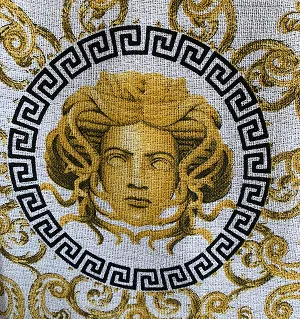
While I was reading this, I stayed in an airbnb that had a Medusa fabric over the couch (shown below). Love those kinds of coincidences!
Read more reviews