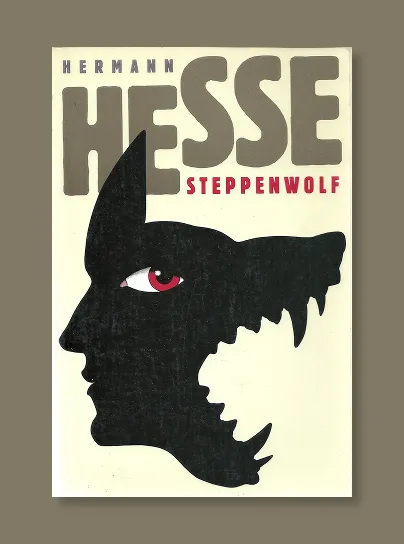
Steppenwolf
Like most of Hesse’s work, this book deals with duality. At the beginning, we find the protagonist on the far end of a polarity, calcified, and stagnate in his routines, thoughts and feelings. By a series of dubious circumstances, he finds himself pulled to the opposite end of the polarity into a frivolous world of sensation and pleasure. On both ends of the extreme he wants to die because he thinks it will free him from the pushing and pulling of his inner voices and desires.
You have no doubt guessed long since that the conquest of time and the escape from reality, or however else it may be that you choose to describe your longing, means simply the wish to be relieved of your so-called personality.
Written at a time when Hesse was having a spiritual crisis, this autobiographical existential novel, while sometimes overwrought and cynical, is packed with spiritual truths.
Hesse had married a singer a few years before this book was written and was struggling with his self-concept as a person of serious intellect and the pull of the trifling life that surrounded him. He came to understand that he needed to inject some sex, drugs and rock and roll into his life for balance.
He is nothing else than the narrow and perilous bridge between nature and spirit. His innermost destiny drives him on to the spirit and to God. His innermost longing draws him back to nature, the mother.
The climax of the story involves the ingestion of some psychotropic substances and a few hours in a fun house where behind each door is the possibility to live out ones wildest dreams. This section of the book is gold and is worth reading past the depressing and misanthropic passages that assume the worst in people and situations.
Behind one door, a war between human and machine is going on; behind another he is a young man and, with a single choice to open his heart to love, sees himself living a completely different life. Behind another door is a holy man playing chess with pieces composed of aspects of Hesse’s psyche and the important people in his life. After each game the man laughs, sweeps the pieces off the table, and then sets up another game. Over and over we are shown in different ways that we create our own reality. It’s absolutely brilliant.
You are willing to die, you coward, but not to live…You are to live and to learn to laugh. You are to learn to listen to the cursed radio music of life and to reverence the spirit behind it and to laugh at its distortions.
The first bit of the book is a grind and would benefit from some editing but context is everything. One needs to remind oneself that this was originally written in German so the translation may have removed nuance and added bulk. Also, when this was written (in 1927!) some of the things within it were counter-culture and shocking.
Long passages of wallowing in existential woe notwithstanding, this is worth reading. Hesse manages to shine light on spiritual truths in a way that delights and makes the reader consider the nature of reality in new ways.
Read more reviews