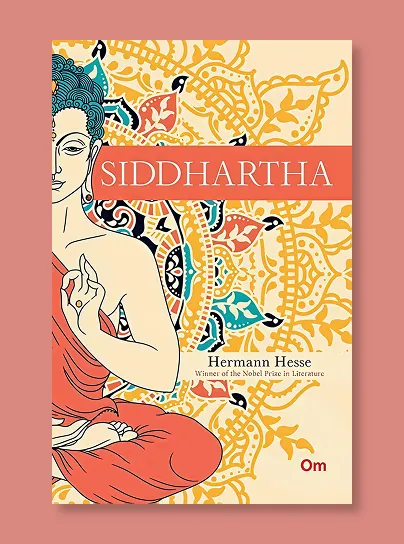
Siddhartha
A classic novel that is just as poignant now as it was when it was published over a hundred years ago. (It's riddled with orthographic and punctuation errors but we can easily overlook those.)
I was in my 20s when I discovered Hesse and read all of his books, enamored by the way he wrapped spiritual understandings in allegory and the novel format. He broke down big, metaphysical topics in a way that made them easy to understand. He focused a lot on the polarities that constitute life.
I had to become a fool, to find Atman in me again. I had to sin, to be able to live again. Where else might my path lead me to? It is foolish, this path, it moves in loops, perhaps it is going around in a circle. Let it go as it likes, I want to to take it.
This novel is more obvious in it’s spiritual focus than his other books as its protagonist is a Brahmin who is seeking enlightenment.
We follow Siddhartha as he moves through the wildly extreme phases of his life; as he goes all the way to the ends of a polarity to exhaust those desires and to realize that what he is seeking isn’t found there. I can relate so hard to his path!
Ultimately, Siddhartha turns to Nature to gain the understandings he’s seeking. The river is a source of Truth for those who can hear it.
There are many things to learn from the river like that it moves constantly, that it is the same yet is new in every moment, and that water always seeks depth, striving to sink downward. Siddhartha also learns from the river to listen, to wait with an open heart without judgement.
"Yes, Siddhartha," he spoke. "It is this what you mean, isn't it: that the river is everywhere at once, at the source and at the mouth, at the waterfall, at the ferry, at the rapids, in the sea, in the mountains, everywhere at once, and that there is only the present time for it, not the shadow of the past, not the shadow of the future?”
While Hesse was writing this novel, he immersed himself in Hindu and Buddhist scripture and took his time with the ending because he wanted to have at least a glimpse of the level of consciousness that Siddhartha experiences as an old man in order to write about it truthfully.
Slowly blossomed, slowly ripened in Siddhartha the realisation, the knowledge, what wisdom actually was, what the goal of his long search was. It was nothing but a readiness of the soul, an ability, a secret art, to think every moment, while living his life, the thought of oneness, to be able to feel and inhale the oneness.
The understanding Siddhartha arrives at is that love of what is, as it is, is the path to enlightenment.
There is a particularly powerful passage in which he tells his childhood friend that it's not enough to recognize that something can become divine over time. The truth is that everything has the divine in it right now and that everything is made of the love of the Oneness.
There are so many spiritual truths in this! It's a must-read for anyone interested in personal evolution.
Read more reviews