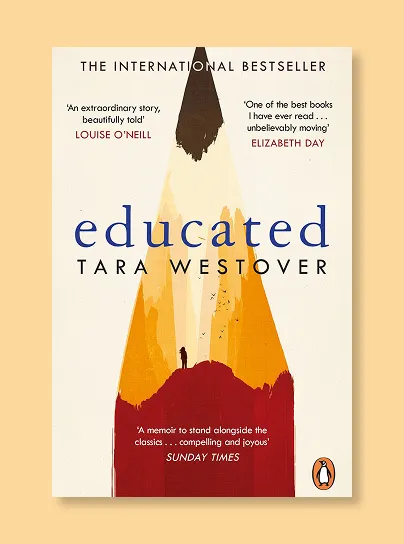
Educated
This is hard to read. Not because the writing is poor but because it is primarily about growing up in an ignorant, abusive, violent and cruel family. I had a lot of strong feelings while reading this.
With clear-eyed transparency, the author shows us what it's like to grow up in an insular, fundamentalist religious family lead by a small, cowardly man who casts a large shadow.
The rest of the night was taken up by my father’s lecture. He said Caroline’s class was one of Satan’s deceptions, like the public school, because it claimed to be one thing when really it was another. It claimed to teach dance, but instead it taught immodesty, promiscuity. Satan was shrewd, Dad said. By calling it “dance,” he had convinced good Mormons to accept the sight of their daughters jumping about like whores in the Lord’s house.
For most of the book, we learn how naive she was and how her thinking had been manipulated by her father, the unquestioned patriarch and preacher of her family. The family owned very few books (most were antiquated textbooks) and she was not allowed friends, school, or television which might have given her another perspective.
Shopping was forbidden on the Sabbath—I’d never purchased so much as a stick of gum on a Sunday—but Mary casually unpacked eggs, milk and pasta without acknowledging that every item she was placing in our communal fridge was a violation of the Lord’s Commandments.
Not only did her father not allow anyone to visit the doctor or dentist (even in life-threatening emergencies), he took away all protection from potential disasters: gloves, hard hats, seatbelts, even seats in the car, preferring to let angels protect his family. It’s infuriating and upsetting, especially if you’re not a stranger to familial violence. The casual cruelty of the men and boys in the house is unsettling on deep levels.
She doesn’t begin to get clued in to her conditioned, destructive thinking until well past 60% of the book. By then she has left home and done so well at college that she has been granted a scholarship to Cambridge University in England.
I had come to believe that the ability to evaluate many ideas, many histories, many points of view, was at the heart of what it means to self-create. If I yielded now, I would lose more than an argument. I would lose custody of my own mind. This was the price I was being asked to pay, I understood that now. What my father wanted to cast from me wasn’t a demon: it was me.
A lot of the later part of the book shows us how difficult it is to reconcile the person she’d become from where she’d come from. She puts herself in danger and discomfort again and again trying to bridge the gap but in the end decides to save herself and the reader wonders why it took her so long to get to that conclusion.
From the moment I had first understood that my brother Richard was a boy and I was a girl, I had wanted to exchange his future for mine. My future was motherhood; his, fatherhood. They sounded similar but they were not. To be one was to be a decider. To preside. To call the family to order. To be the other was to be among those called.
This is a rags to riches story with a steep incline. The author begins as an ignorant unschooled girl in rural Idaho and ends up an author with a PhD in intellectual history from Trinity College, Cambridge. It's an amazing story, well-told, but not a easy read.
Read more reviews