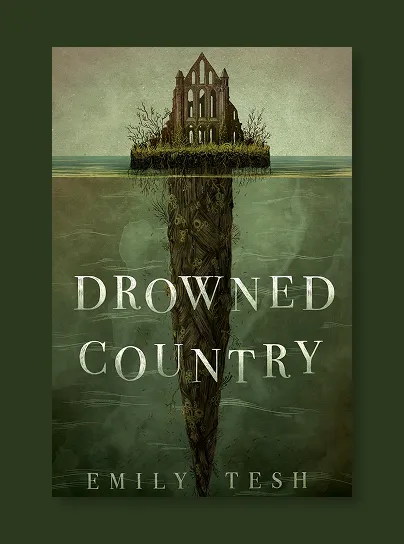
Drowned Country
Book 2 of the Greenhollow Duology
This story begins two years after the ending of the first book. Everything has changed; some characters are languishing while others are getting on with things.
When a particularly difficult case comes up, Silver’s mother returns to the family house to ask her son for assistance. When he says yes, the gang gets back together to rescue a young woman from certain death.
Like the first book in the series, the climatic scene of the story is about one paragraph long, which is far too short. Indeed, like the first book, this one is also a novella. Why? If the author had taken the time to really develop this story it could have been super interesting and the book would have been average sized.
Silver had always striven to give his mother the impression that he was rather feeble, barely able in fact to lift anything heavier than a dictionary or perhaps his guitar, since he knew very well that otherwise he was likely to get dragged willy-nilly into activities involving a tiresome amount of running, fighting, and shooting. It was oddly irritating to find that he’d succeeded so well.
The first book has to do with an undead creature that terrorizes a village each Summer Solstice. This one has to do with a 400-year old vampire and the Fairy Queen. It would seem there would be action, mystery, and exciting unexpected turns of plot but by the time we get to the vampire he’s already dead and the Fairy Queen is given just three short paragraphs. It’s a disappointment.
The author clearly has a good imagination, some passages are quite nice, in fact, but in clutch moments, she backs down from strong creative choices: she doesn't go there. The characters are drawn with cursory strokes that hint of something fantastic but they aren’t developed fully so we care less about them than we could.
Perhaps the mediaeval hall had been attractive in a foursquare way, but it had been added to patchwork-fashion over the centuries, developing wings and cupolas and even a small pointless tower like an unfortunate youth developing boils.
As far as Silver could tell, no one with any sense of grace or proportion had ever been consulted on a single one of the additions. Honestly, the creeping vines swallowing the place improved it, if only because they suggested some sort of unity of purpose.
One nice thing about this story is the tenderness between the two male protagonists. The author does a good job of writing about the awkwardness that is often present in an estranged relationship.
Read more reviews